
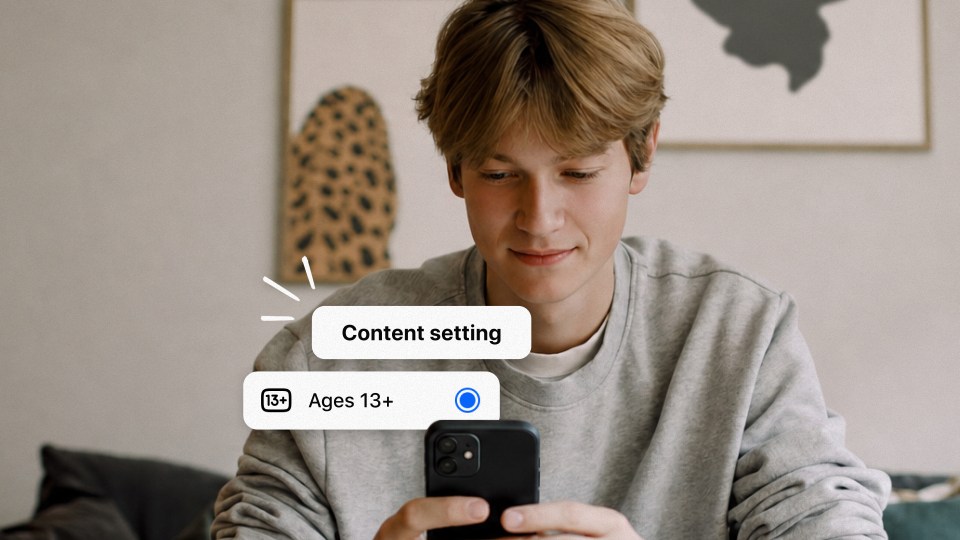
Last October, we updated Instagram Teen Accounts in the US, UK, Australia, and Canada, defaulting teens into a new 13+ content setting. Inspired by movie ratings criteria and parent feedback, this setting is designed to help teens see age-appropriate content by default, and 9 out of 10 teens have remained in this setting since its launch. We also introduced a stricter setting called Limited Content, for parents who prefer an even more restrictive experience for their teen.
Today, we’re sharing an update on this work, including testing a new way to help make sure teens aren’t repeatedly seeing certain types of content.
Expanding Our New 13+ Content Settings To Instagram, Facebook and Messenger Teen Accounts Globally
We’re expanding our 13+ content settings to Teen Accounts globally across Instagram, Facebook, and Messenger. Facebook’s new 13+ default setting is designed to hide content that’s inappropriate for teens in places like Feed and Reels, and to limit teens’ ability to interact with Profiles, Pages, Groups and Events that primarily post inappropriate content. On Messenger, the 13+ default setting limits teens’ ability to view links to inappropriate Facebook content, or to chat with accounts that primarily share inappropriate content on Facebook. The Limited Content setting will also become available on Facebook and Messenger later this year.
As we’ve expanded the new content settings to more countries and apps, we’ve also continued to invite parents around the world to rate Facebook and Instagram content and tell us if they think it’s appropriate for teens. We’ve heard from hundreds of thousands of parents who have rated more than 15 million pieces of content. In our most recent survey at the end of April, where parents in the US, UK, Australia, and Canada reviewed Facebook content that had been recommended to teens in their respective countries, fewer than 2% of posts were considered inappropriate for teens by most parents.
A New Way to Help Prevent Teens From Repeatedly Seeing Certain Types of Content on Instagram
We’re also continuing to explore other ways to help make sure teens are having positive, age-appropriate experiences on our apps. We recognize that some content — like posts about nutrition, weightlifting, or how to cope with anxiety — can be helpful, but it should be balanced with other types of content rather than shown repeatedly. That’s why we’re testing ways to limit teens from seeing too many posts of this kind in one go, including in Explore, Feed, and Reels.
An External Assessment To Stress-Test Our Teen Account Content Settings
To help make sure our new content settings are working to deliver the positive, age-appropriate experience we want for Teen Accounts, we asked Alice (formerly ActiveFence) to evaluate our Teen Account settings and perform sophisticated, adversarial stress-testing. Alice is made up of online safety experts with extensive experience in stress-testing systems designed to keep people safe.
Alice compared mature themes, based on Meta’s age-appropriate guidelines, found on Instagram, a leading competitor, and in movies rated 13+. This provided a helpful benchmark to understand what teens could see on Instagram Teen Accounts compared to elsewhere. Alice’s assessment found that:
- Instagram Teen Accounts in the default 13+ setting saw 68% less mature content than on the competitor’s teen experience;
- Instagram Teen Accounts in the stricter Limited Content setting experienced an additional layer of protection, seeing 96% less mature content than on the competitor’s teen experience;
- Where Instagram Teen Accounts did see mature content, it was less intense than the mature content seen on the competitor and in movies rated 13+;
- Instagram blocked mature search terms more frequently than its competitor;
- The following functionalities worked as described: Instagram Teen Accounts are defaulted into the 13+ content setting; teens can’t select the More Content setting without a parent’s permission, and teens in the Limited Content setting can’t see or post comments.
Alice’s analysis identified two areas for improvement, which we worked quickly to address.
- Instagram Teen Accounts already had safeguards in place to prevent interaction with accounts that regularly share age-inappropriate content. When Alice’s assessment identified a few exceptions, we immediately updated our detection signals to better catch them. As the Alice report notes, “these improvement measures were subsequently retested and found to be effective prior to publication.”
- In the rare instances where Alice’s researchers encountered mature content on Instagram, it mostly involved “risky stunts” or “viral challenges.” After review, we found that ”car surfing” — a newly popular trend — wasn’t yet covered by our policies, unlike ”subway surfing,” which was already restricted for teens. We moved quickly to update our policies and restrict this content for teens.
We are encouraged by these results, and will continue to rigorously stress test our systems to help us keep improving. More details on Alice’s results and the methodology are available here.
Note: There are lots of differences between social media and movies. We didn’t work with the MPA when updating our content settings, and they’re not rating any content on Instagram, and they’re not endorsing or approving our content settings in any way. Rather, we drew inspiration from the MPA’s public guidelines, which are already familiar to parents, as well as feedback from parents. Our content moderation systems are not the same as a movie ratings board, so the experience may not be exactly the same.