
Our enforcement to date
As of 30 June 2026, we have removed access to more than 750,000 accounts on Facebook and Instagram in Australia that we assessed as belonging to people below the minimum age of 16.
That figure includes over 500,000 Facebook and Instagram accounts we removed in the lead-up to the law taking effect, which we reported in January, and the accounts we have continued to remove in the months since.
Enforcement is ongoing, and these numbers will continue to grow. We report our enforcement to the eSafety Commissioner and will continue to publish updates periodically in order to be transparent with the public.
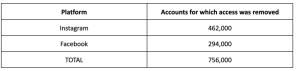
Figures for 1 December 2025 to 30 June 2026.
The measures behind those numbers
Identifying age online is not a single check. It is a continuing process, and the figures above reflect a series of improvements we have made throughout this year, building on the approach we set out in May and explained for families in June:
- AI-powered proactive detection. We use AI to analyse profiles — including posts, comments, bios and captions — for contextual clues that an account may belong to someone under 16, such as birthday celebrations or mentions of school grades.
- Simplified reporting. We have made it easier for parents and the community to report a suspected underage account, both in our apps and through our Help Centre for Facebook and Instagram.
- AI-driven review of reports. Reports of underage accounts are now supplemented by AI-driven review, delivering higher accuracy and faster resolutions than human review alone.
- Preventing re-registration. We have strengthened our systems to detect and prevent someone from creating a new account after their previous account was removed.
- App Store age rating. We updated our Apple App Store age rating to 16+ in Australia.
Helping Australian parents understand the change
Enforcement is only part of the job. Between June and July we ran an education campaign across Facebook and Instagram in Australia that reached approximately 1.3 million people, pointing them to practical guidance on how we detect and remove under-16 accounts, what happens to a teen’s account and memories, and how to check and correct a stated age.
We think this matters. A young person using social media without a parent or guardian knowing is harder to support, not easier, and keeping parents informed is part of making these protections work.
Where to from here
We share the Australian Government’s goal of ensuring young people have safe, age-appropriate experiences online, and we are meeting our obligations under the law. We will continue to invest in new ways to understand age more reliably while protecting privacy, and we will publish further updates as this work continues.
Our primary concern is that platforms are not taking a consistent approach to how they are removing teens. There should be a single reliable age signal delivered at the operating system or app store level. Age could be verified once, when a young person sets up their device or downloads an app, rather than repeatedly across the dozens of apps they use.
Update 9 November 2026:
Using Apple’s Age-Range Signal
In Australia, we’ve begun using Apple’s age-range signal as another method to help understand age. The process is simple. When a parent sets up a smartphone for their teen, they have the option for the app store to confirm the age of the person using the device and assign them an age range. Then, each time the teen downloads an app, Apple passes that age range to the developer — Meta, for example — confirming whether the teen meets the app’s age requirement.
We’re voluntarily using this signal, but as long as collecting it and sharing it remains optional for app stores, and using it remains optional for developers, teens will receive inconsistent protections across the many apps they use. We’ve long supported legislation requiring age verification and obtaining parental consent on the app store. One verified signal from people’s devices, shared consistently with all apps, is far more effective and privacy-preserving than asking every platform to verify age individually. And the work developers like Meta do to estimate age can be used as a backstop to help correct mistakes and feed them back to the app store for correction across all the apps a teen uses


